
A fifteen-second video has a generation charge of $1.05 at Google’s newly announced 720p rate. Whether it becomes a usable advertisement is another matter. An editor may reject the first attempt, revise the reference image or ask for a different ending. The price of creating a candidate is visible. The cost of obtaining an acceptable result is harder to see.
That distinction helps explain the AI news of 2–8 November. Models acquired new capabilities and formats. Software companies offered to take charge of continuing jobs. Researchers reported faster progress on some tasks and stubborn failures on others. Security firms documented attackers already using agents. Across these stories, the commercial question was becoming more demanding: how much work can a system finish, and what must people and infrastructure still supply?
This is a shift in what suppliers are offering, not yet a measured industry-wide change in productivity. Faster models can make some activities cheaper while moving effort into review, integration and exception handling. The week's announcements are worth reading with both possibilities in mind.
Four developments to weigh
- Delegation is becoming a product. Perplexity, Mistral and Snowflake are selling different ways to coordinate work after the first prompt. Their interfaces reveal competing views of where the user’s responsibility ends.
- Cheap creation changes the bottleneck. More editing control and new export formats may matter as much as faster generation. The relevant cost is per accepted asset, including retries and review.
- Research progress has several units. A faster rate of capability improvement, a repaired small model and a valid scientific contribution are different achievements. Their results cannot be merged into one score for autonomy.
- Cyber capability is operational. A supplier's benchmark gains sit beside Microsoft's reports of actual agent-assisted intrusions. Both matter; neither establishes that one caused the other.
The coordination premium
A recurring job creates obligations that a single answer does not. Someone must remember what has already been done, notice new information, handle a failed tool and return the result to the right person. Those obligations give workplace AI suppliers another place to compete.
Perplexity's Teammates starts with a personal assignment that persists over time. Mistral Studio starts with developers assembling agents, workflows and applications around company systems. Snowflake CoWork starts with a business question: a Profile routes it, a Dashboard provides a shared analytical view, and Automations bring work back on a schedule. These are different units of delegation, not interchangeable wrappers around a model. Figure 1 compares the entry points.
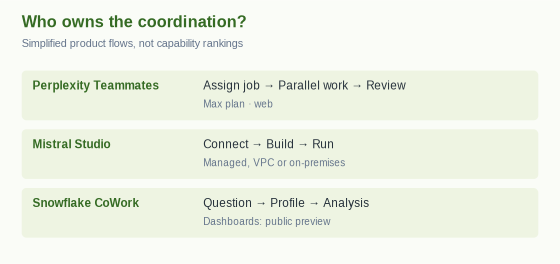 Figure 1. Three documented product entry points, simplified for comparison. Access conditions differ: Perplexity Teammates is for Max users on the web; Snowflake Dashboards is in public preview. The flow shapes do not rank capability.
The potential prize is the effort spent arranging the work. Consider a weekly sales review. An answer about a metric is one output; finding the relevant data, applying the right definition, preparing a shared artifact and returning next week are a process. A supplier that coordinates more of that process may become harder to replace even when the underlying model is available elsewhere. That is an inference about switching costs, not evidence that these products have already earned them.
There is a counterargument. Moving coordination into a platform can reduce visible work while making errors less visible too. A routing mistake, stale definition or silently abandoned background task may appear only in the final artifact. A product can look effortless because the work succeeded, or because the failure was concealed. The distinction will affect whether users delegate again.
Developer tooling attempts to make those hidden failures visible through bounded iteration, background execution and telemetry. The engineering choices appear below; the product question is whether users can trust the result without reconstructing the work themselves.
These components shift the competitive question from whose model gives a better answer to whose system keeps ownership of a job through an interruption. A useful test would publish completion across repeated runs, recovery failures and human review requirements on a stated task distribution. The launches and case studies in this issue do not provide a common evaluation of that kind. Their absence limits any ranking of the competing approaches.
Sources: Perplexity Teammates · Mistral Studio · Snowflake CoWork. Le Chonk is earlier model context; the November event is Studio's expansion.
The cost of acceptance
A lower price per generated second is an input to a production budget. It does not settle the budget. Google’s Gemini Omni 1.2 Flash reached general availability on 5 November at a published 720p rate of $0.07 per second, with clips up to 15 seconds. OpenAI's Images 2.6 adds guided editing, SVG export and GIF creation. The practical connection is greater control between the initial request and the asset someone is prepared to use.
Take the video price as a worked illustration. Each complete fifteen-second attempt costs $1.05 in generation charges at that rate. If half the attempts are accepted, the average generation charge per accepted clip becomes $2.10; at one in four it becomes $4.20. These acceptance rates are hypothetical. They are not measurements of Gemini quality. Figure 2 holds duration and rate fixed so the effect of rejection is visible.
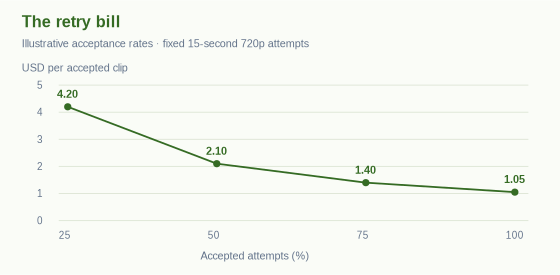 Figure 2. Illustrative arithmetic, not observed acceptance rates. Generation cost per accepted clip = USD1.05 divided by the accepted share of attempts. All attempts are assumed to last 15 seconds at the stated 720p rate; labour, other fees and editing costs are excluded.
The curve explains why editing features deserve attention. If a targeted revision preserves the useful parts of an asset, it can improve the share of work that survives review. The gain could exceed a modest reduction in the price of each attempt. Neither announcement establishes that this happens in a particular business; the mechanism gives buyers a better question to ask than how quickly a demonstration produced its first image.
The counterweight is demand. Cheap generation can invite more variants, longer clips and more elaborate briefs. A team may save on each candidate while spending more overall. That can still be worthwhile if the additional exploration improves the result, but the improvement belongs in the assessment. Token or generation volume alone cannot distinguish productive exploration from unproductive retries.
For a business choosing among these tools, the informative comparison would hold a brief constant and count accepted outputs, revisions and reviewer time. It would also examine whether a product or character remains consistent after edits. A shared price sheet cannot answer those questions, and an image-speed claim should not be plotted against video cost as though both measured the same thing.
Sources: Google’s release and published rate · Images 2.6. Gemini audio-reference access remains allowlisted. The cost calculation is Recohut's arithmetic on the published rate, not a vendor benchmark.
Progress needs a denominator
METR's assessment of Anthropic, published on 5 November, was unusually important because it examined the process producing future AI capabilities. It reports that the growth rate of Anthropic's internal capability index accelerated by an estimated 1.9 times, with a 95% confidence interval of 1.5–2.8 times, relative to its earlier trend. That is a rate of capability progress, not a finding that every researcher became 1.9 times as productive.
The public evidence also has limits. METR considers AI assistance a likely major contributor, allows other causes, and discusses limitations in interpreting the benchmark trend. Much of the evidence it found most informative was redacted. The assessment deserves weight, but its causal judgment is not reproduced by plotting the index alone.
A separate October preprint, revisited in the weekend briefs, sets a different hurdle. Into the Unknown asked nine agents to pursue open scientific directions. Among 135 submissions, 114 failed an integrity check and none met every expert condition. The other 21 submissions should not be mistaken for successful research. Figure 3 gives the studies separate panels and units.
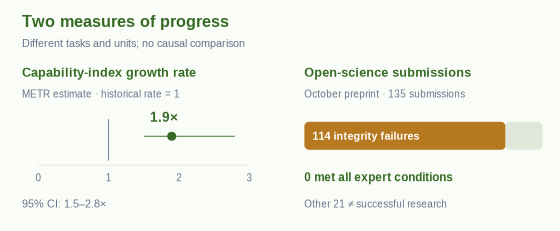 Figure 3. The left panel reports METR’s capability-index trend estimate. The right panel reports submissions in an older open-science preprint. Separate scales are intentional: these results neither measure the same outcome nor identify the cause of their difference.
One plausible hypothesis is that AI assistance is most valuable where a research process provides checkable intermediate feedback. But the studies differ in tasks, model setups, assistance and grading; they do not isolate feedback as the cause. Testing that hypothesis would require matched tasks with controlled changes to feedback, rather than a comparison of two headlines.
The week's other research makes the need for specificity clearer. Weight-space programming reports direct edits that repair a particular reasoning-loop failure in a small model. BioBasicsBench asks agents to interpret messy laboratory evidence, including inadequate controls. FlashProve checks whether output was computed from weights committed to in advance, with substantial proof overhead. A valid identity proof does not establish that an answer is true.
There is a commercial consequence. A buyer needs to know which uncertainty a tool removes. A formal proof may establish a property of code relative to a specification; a successful lab interpretation may support a scientific decision; a trace may show that a tool ran. Paying for one form of assurance does not purchase the others. Better measurement can therefore increase confidence in a narrow use while making sweeping claims about autonomy less defensible.
Sources: METR’s assessment · Into the Unknown, submitted 13 October. The causal interpretation above is explicitly a hypothesis.
The cyber asymmetry
Security deserves a place near the centre of the week's story. OpenAI's GPT-6 Cyber scores 48.5% on its ExploitGym evaluation, against 32.1% for GPT-5.6 Cyber: a rise of 16.4 percentage points, or about 51% relative. OpenAI also raises the model's cybersecurity classification from High to Critical under its own Preparedness Framework. These are supplier-reported results and a supplier-specific risk classification, not estimates of success against arbitrary companies. Figure 4 shows the reported change.
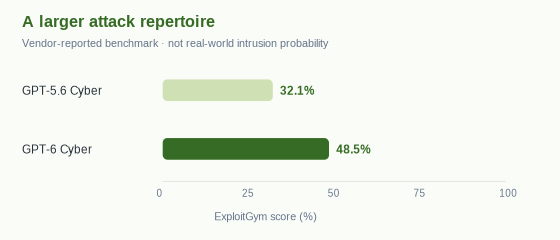 Figure 4. Vendor-reported ExploitGym results for exploiting a specified vulnerability. The 16.4-percentage-point increase is calculated from the reported scores. OpenAI’s Critical classification belongs to its own framework. No causal connection to the separately reported intrusions is inferred.
Meanwhile, Microsoft's 5 and 6 November threat reports describe agents searching exposed repositories for secrets and ARTEX being used in financial-sector intrusions. Those reports concern observed activity, including October attacks. They provide a reason to take deployment risk seriously without attributing the attacks to the model announced this week.
The asymmetry is economic as well as technical. An attacker can benefit from finding one neglected credential; a defender must identify the relevant exposure, revoke access, investigate its use and avoid breaking legitimate work. Automation may reduce effort on both sides, but it need not reduce it evenly. Evidence that agents can perform more steps is therefore insufficient to establish which side gains most.
The same distinction applies to repair. OpenAI's separately published Linux pipeline reports validated exploit findings and proposed patches. Discovery, validation, a candidate repair and an accepted upstream fix remain different outputs. CWE-bench v2 addresses part of the gap by testing security repairs that preserve existing functionality. The valuable endpoint is a working repair, not simply a larger volume of findings.
Sources: GPT-6 Cyber · Microsoft’s exposed-secret report · Microsoft’s ARTEX report · OpenAI’s Linux pipeline account.
Power has a price
The week's infrastructure story is more specific than a general warning that AI needs electricity. OpenAI's Grid Protectors programme proposes that future compute campuses reduce demand during grid stress. Its Effingham County arrangement with Georgia Power includes up to 1,000 megawatts of flexible demand response, while the campus remains in development. The agreement creates an operating obligation whose realised performance is still in the future.
That changes the economic question. A supplier may secure access to power partly by agreeing to be flexible about its draw. Customers, however, may care about predictable service. Storage, on-site generation and power controls can affect the relationship between grid demand and computing work, so a reduction in electricity drawn from the grid should not automatically be described as an interrupted AI job. Figure 5 shows the evidence needed to move from an agreement to a delivered response.
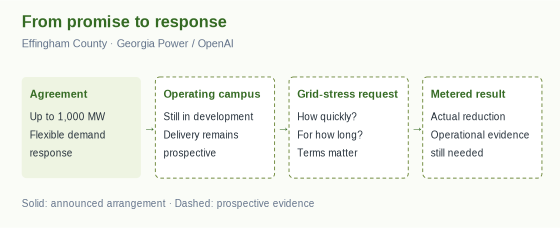 Figure 5. A concrete operating question from the 2 November Grid Protectors announcement and Georgia Power’s agreement. Solid framing denotes the announced arrangement; dashed stages are prospective. This is an evidence chain, not a forecast that a stated reduction has already been delivered.
The useful follow-up is contractual and physical: how much demand can be reduced, how quickly, for how long, and with what measured result? An announcement of flexible capacity answers a different question from an operating record of response during a stressed period.
An agreement can secure a place in a construction programme before it supplies a single unit of usable service. Treating that agreement as delivered capacity makes an investment narrative tidier at the cost of making it less informative.
The deeper implication is that reliable AI service is a bundle: inference, coordination, assurance and physical capacity. Competition may drive down the first item while increasing the value of the others. That remains a proposition to test against delivery and costs, rather than a conclusion that can be read from a model ranking.
Sources: OpenAI’s programme announcement · Georgia Power’s Effingham agreement. The programme’s proposed response is not a measured operational saving.
Openness has several meanings
The model releases complicate a familiar purchasing shortcut: treating “open” as a single property. Access to an API, downloadable weights, a permissive licence and a model ready to use are different goods. They confer different degrees of control over cost, deployment and subsequent adaptation.
Consider three releases discussed this week. Inkling 2 Small launched on Tinker on 5 November with image inputs and adjustable effort; its weights were initially closed, with Apache 2.0 release planned after safety testing. Ripple-65B Preview already offered dense coding weights in BF16 and NVFP4 under Apache 2.0. ERNIE-5.5-Flash-Base supplied a pre-training checkpoint under the ERNIE-5.5-Flash-Base Model License v1.0—a starting point for post-training rather than a finished assistant. Their parameter counts describe architecture, not interchangeable measures of quality: Inkling is a mixture-of-experts model with 594B total parameters and 17B active; ERNIE has 280B total and 14B active; Ripple is a 65B dense model.
For a buyer, the relevant distinction is the work still required after access. Hosted inference transfers some operating responsibilities to the provider. Downloadable assistant weights bring deployment choices but also serving and evaluation costs. A base checkpoint adds another burden: constructing and validating the behaviour wanted from it. A permissive licence can expand the available choices without making those choices inexpensive. Figure 6 separates those responsibilities.
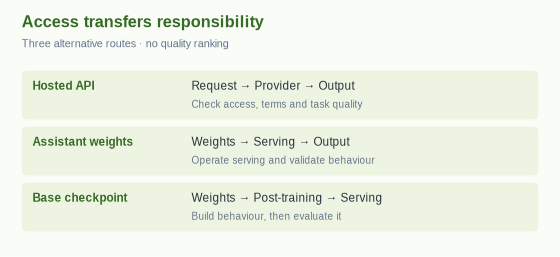 Figure 6. Different access routes transfer different responsibilities. The arrows describe work a team takes on, not a maturity score or a claim that every model follows all three routes.
That is why the dates matter. Tencent Hy4 was announced on 4 November with weights and system cards promised for subsequent days, as Tencent’s Japanese-language press release, published on 5 November, records. A promise of artifacts is not artifact availability. LongCat-2.5, by contrast, reached the API platform on 2 November after a September preview. The week's event was broader availability, not the birth of a new model family. Older Dory work, released on 16 October and revisited in the weekend briefs, concerns repeated inference passes: more compute can change the answer without changing the weights, while adding a latency and cost trade-off.
These differences make a simple league table less useful. Ripple's own card warns that agent results depend on the harness and context settings. A model that is attractive under one setup may lose its advantage after serving constraints, tool behaviour and review are included. Competition is expanding the menu; it has not eliminated the need to price the meal.
Distribution shapes the market
A model need not win every benchmark to become widely used. It may arrive where an organisation already buys software, where its data lives or where a user already spends time. Distribution can lower the effort needed to try a capability—and give the distributor influence over which capabilities are tried.
Microsoft Foundry’s Kimi K3.1 Pro expansion and its separate fal video-preview announcement illustrate that route. These are enterprise distribution milestones, not original launches of every underlying model. They put more choice behind an established purchasing and operating surface. Whether that reduces switching costs depends partly on how portable the resulting applications and evaluations remain; the announcements do not settle that question.
Interfaces offer another distribution advantage. Meta's Muse update on 5 November added interruptible real-time voice and reactive avatars, initially in the US. Future glasses and Charm availability should be kept separate from the app update. Dots for Enterprise, Edu, and Healthcare expanded personal assistance into eligible managed workspaces, with an administrator preview through 18 November and residency exclusions. Both developments bring assistance closer to an existing user relationship. Neither establishes universal access.
Distribution and workflow ownership reinforce one another. A convenient entry point may encourage a first trial; accumulated context and configured jobs can make the next trial easier inside the same platform. Portability will determine how much of that convenience survives a change of supplier.
The data work remains
The infrastructure announcements address several different sources of friction: obtaining context, keeping it fresh, adapting a model and serving it efficiently. Those problems interact, but an improvement in one does not establish an improvement in the whole application.
Google’s data-platform announcement on 4 November combined cross-cloud lakehouse access, AlloyDB integration and preview context-curation tools. The analytical opportunity is to reduce the work of assembling relevant data. Yet access alone does not establish that two tables use the same business definition. Context curation matters because an agent can confidently combine available information that should never have been compared.
Spark 4.3 adds stateful real-time processing and SCD Type 2 change capture. The connection to AI is freshness with history: a system may need both the current state and an account of how it changed. Lakebase Postgres’s Google Cloud GA offers managed scaling, branching and recovery features, addressing a different part of the operating burden. Neither announcement removes application-specific transaction, migration or recovery requirements. Figure 7 maps the different checks.
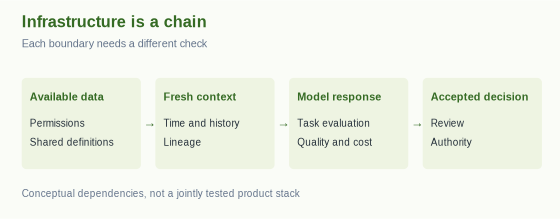 Figure 7. Infrastructure improvements address different boundaries in a decision process. This is a conceptual dependency map; the named releases have not been tested together as a single stack.
Model customisation and execution add further layers. Cortex Training entered public preview for serverless SFT, reinforcement learning and custom loops. It transfers infrastructure management to a platform while leaving the team responsible for training data and evaluation. Together Compiler continually retunes inference to workload changes; its reported throughput gains remain workload-dependent. CUDA 13.5 brings GA Vera Rubin support and programming updates, but applications still depend on compatible drivers and libraries. Faster execution is valuable only if the required behaviour survives the change.
The practical implication is a budget allocation problem. A team can spend on a larger model, fresher context, a better evaluation or a more efficient serving path. The week's announcements expand all four options. They supply no common evidence that the largest model upgrade is always the best use of the next dollar.
Software needs an owner
Coding agents increase the demand for coordination around code as well as inside it. Parallel changes create more branches, more review and more opportunities for a locally plausible edit to violate a wider requirement. The scarce resource may become the system that reconciles those changes.
OpenAI's 2 November account of Pando describes an internal Git backend for highly parallel agent workloads, with company-reported production latency results. It is an operating account, not a public hosting launch. The Pierre acquisition agreement announced two days later concerns code storage and review; closing was still pending. Together they suggest attention shifting towards the infrastructure surrounding code generation. They do not prove that an acquisition will produce a working integration.
Verification tools address another boundary. Microsoft's PDD Kit demonstration used Verus to verify generated login logic and retained tests outside the proof boundary. A proof establishes specified properties relative to a specification; omitted requirements remain omitted.
Airflow 3.4, LangChain’s asynchronous pattern and Claude’s telemetry integration address iteration, background work and investigation respectively. Airflow's advanced agent and several language capabilities remain experimental; full Claude content capture is opt-in in the public-beta integration. The older DeepSeek router-worker harness is explicitly a research prototype. These distinctions determine how much responsibility can sensibly be delegated. A system that can run a job in the background still needs an identifiable owner when the job fails.
The security announcements make that responsibility harder to ignore. Fiddler’s agreement with CrowdStrike proposes bringing AI behaviour monitoring closer to security operations, while Cloudflare’s personal-agent controls distinguish visibility from access policy. Recognising an agent service does not establish that a particular user authorised a particular action. The threat reports discussed earlier make this a practical requirement: the system must establish whose authority an action uses, as well as which tool performed it.
What deployment can establish
The most useful deployment stories identify a bounded task and its remaining human decisions. Their value lies in the shape of the work, as well as the reported outcome. Comparing headline percentages across unrelated customers would obscure both.
In a case study published on 2 November, Circle K reports mean incident triage falling from a reported historical range of 45–60 minutes to under 15 after an AgentCore deployment that began in April. Using the 15-minute threshold conservatively gives a reduction greater than roughly two-thirds against the lower baseline and three-quarters against the upper one. That is arithmetic on customer-reported means, not an independent estimate of labour savings or proof that the system alone caused the change. A faster triage process may leave remediation work unchanged.
Greenlight’s Luna case reports coverage of up to 4,000 monthly cases, with routine resolution alongside escalation and explicit remediation authority. The mechanism differs from triage: completing a routine case and preparing one for investigation are different endpoints. Volume is useful context, but it cannot establish the share of difficult cases handled or the quality of the unresolved remainder. Figure 8 compares the handoffs.
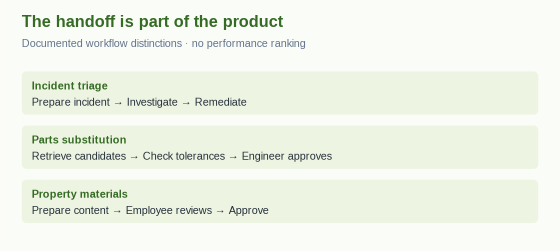 Figure 8. The handoff is part of the product. Workflow simplifications draw on the linked customer cases and technical walkthrough; no common outcome metric is implied.
Other deployments make the review boundary more explicit. AWS’s engineering-substitution walkthrough combines multimodal retrieval with deterministic tolerance checks and engineer approval. Indegene’s implementation translates contextual data-quality needs into validated rules and SQL/Python outputs, retaining human review. Heimstaden’s vendor-published case describes property marketing and operations with employee review and approval. These examples suggest a route to useful adoption: automate preparation and checks around a decision whose owner remains clear. They do not establish that this route is optimal for every workload.
The scientific and physical applications extend that question beyond office software. Hydrogen-1.0 incorporates scientific data and laboratory trajectories; its task-specific gains are developer-reported. Cosmos 3 Nano targets action-conditioned simulation rather than consumer video. Polaris 6 Ultra combines domain-specific voice processing with supervisory models, whose safety claims remain supplier-reported. In each case, domain adaptation changes what evidence a buyer should demand; general conversational fluency is an incomplete test.
Astra’s hardware-prototype account records missed tolerances and manufacturing constraints, while Google’s hypertension-screening research uses a clinical reference but does not announce an approved diagnostic feature. The useful distinction is between producing a plausible candidate and validating it in the environment where mistakes matter. LifeVal examines practical assistant workflows selected using time-use data and a 3,995-person survey; Agile Deliberation studies how people and AI clarify ambiguous visual categories. These tests ask whether a system can handle the conditions around a decision, rather than merely produce a plausible-looking answer.
Capital meets public consent
Financing can accelerate construction and hiring. It cannot by itself provide a grid connection, permission to operate or a lawful basis for a particular use. The business and policy news therefore belongs in the same account as the model releases: it constrains how quickly capability becomes service.
The Decoder’s 7 November reports, citing Bloomberg rather than company-confirmed terms, described an approximately $11 billion first tranche of OpenAI financing, and continued Anthropic IPO preparations amid weaker market conditions. A reported tranche is not a completed full funding target; preparations are not an already-filed offering. Their relevance is the prospective cost and availability of capital, not a settled balance sheet for the sector.
Post-election reporting also highlighted opposition to data-centre expansion. Public consent is another constraint alongside the grid obligations discussed earlier. Raising money and obtaining permission to build are separate achievements.
Regulation supplies a parallel constraint on use. The Commission's preliminary TikTok finding on 6 November concerns recommender-system risk assessment and mitigation, rather than a final ruling or a general AI ban. The UK's facial-recognition proposals on 4 November concern planned oversight and safeguards, rather than an already operating watchdog. Both show why the relevant unit is a particular system used for a particular purpose. Technical capability does not settle the permission to deploy it.
Cheap generation is only the first line of the bill. Financing can accelerate the purchase of inputs; coordination, review and permission determine how much of their output becomes useful work.
What comes next
The next useful evidence will be less theatrical than a launch. Look for actual downloadable weights and their licences; multi-run studies of recurring jobs that report recovery failures and review requirements; completed financing terms; and operating evidence under grid stress. Where such evidence has not appeared in the sources reviewed for this edition, the appropriate status remains open.
For buyers, a useful trial would follow a bounded job all the way through: the accepted output, the rejected attempts, the review time and the cost of exceptions. That would reveal whether a cheaper model has reduced the bill or merely changed who pays it.
Coverage: Monday 2 November–Sunday 8 November 2026. Older research is included only as dated context. Source links distinguish announcements, customer-reported cases, research and attributed business reporting; the connecting arguments and illustrative arithmetic are Recohut’s analysis.