Train a custom model only when prompting and retrieval have stopped closing a measured gap. For most teams that means LoRA supervised fine-tuning of an open-weight model on a few hundred to a thousand good examples; preference tuning or reinforcement learning only for judgement or verifiable tasks; and continued pretraining rarely. In 2026 that training is increasingly bought as a metered service on open weights, because fine-tuning of closed models is shrinking.
On October 19, 2026, Google made supervised tuning for Gemini 3 generally available. Two weeks later, on November 3, Snowflake announced a public preview of Cortex Training, a service where your code runs a training loop and Snowflake's GPUs do the heavy steps. And on January 6, 2027, two months from now, OpenAI will stop letting even its existing customers create new fine-tuning jobs. So fine-tuning is not dying. It is moving from closed models to open-weight ones, and from a research chore to a metered service.
That makes an old question urgent again: when should a team train its own model, how, and where? This guide covers the options from prompting to continued pretraining, when to escalate, the methods and tooling, who sells what, what it costs and what can go wrong. Prices and vendor status are as of November 2026; the market reprices quarterly, so check any number before you sign.
The customization ladder
Custom model training covers nine different interventions, from editing a prompt to pretraining a model from scratch. Think of them as a ladder (Figure 1): each rung costs more and changes the model more deeply, so you climb only when the rung below has stopped helping. Most teams need only the middle rungs.
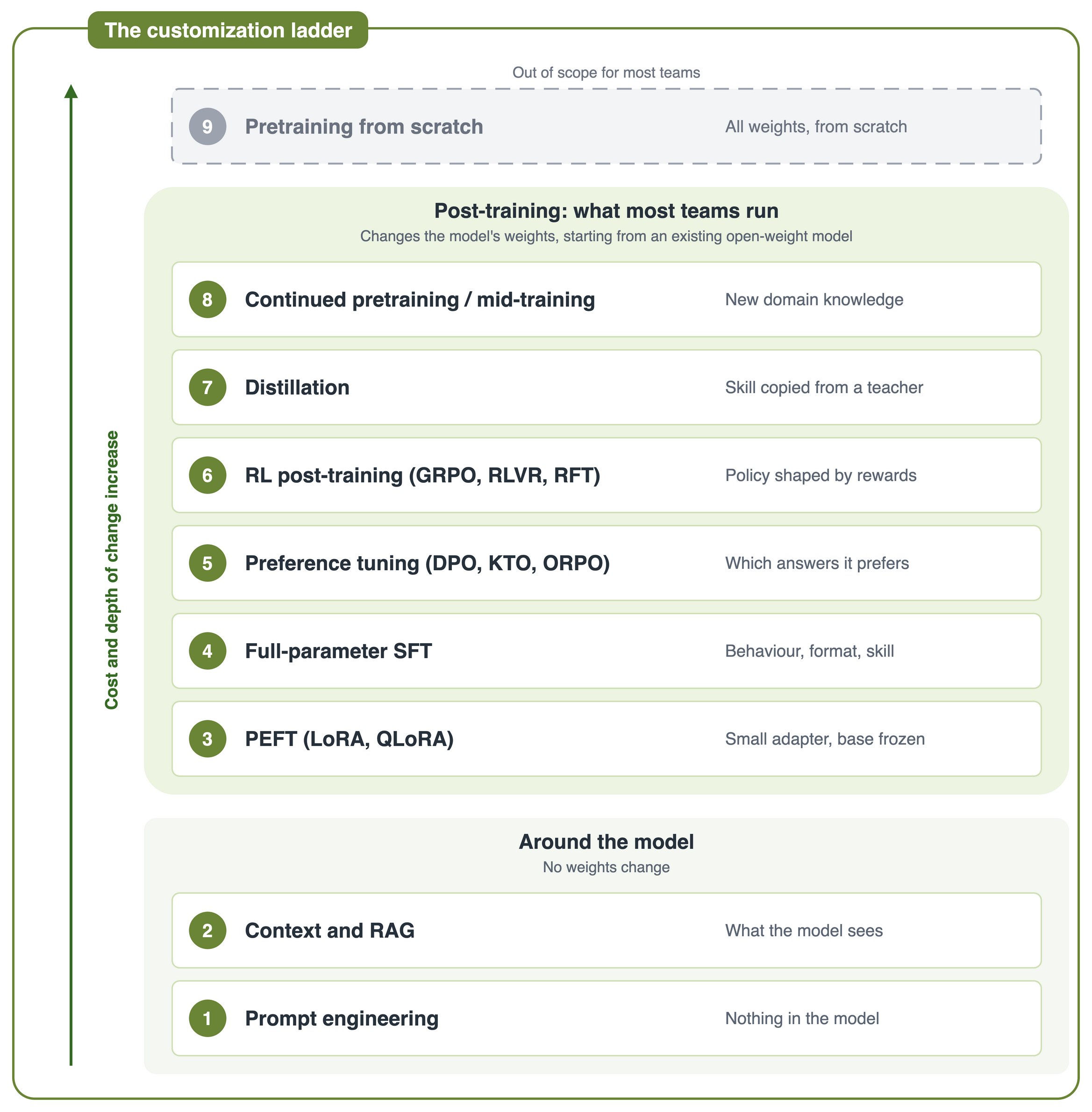 Figure 1. The customization ladder. Cost and depth of change both rise with each rung; most teams work on the highlighted middle rungs.
| Rung | What it is | What changes | Cost profile |
|---|---|---|---|
| Prompt engineering | Instructions, few-shot examples, output schemas | Nothing in the model | Engineering time |
| Context and retrieval | Retrieval, tool access, long context | What the model knows at call time | Inference plus retrieval infrastructure |
| PEFT (LoRA, QLoRA) | Small adapter layers trained on frozen base weights | Behaviour, format, style, task skill | Tens to hundreds of dollars per small-model run |
| Full-parameter SFT | Every weight updated | Same as above, deeper | About 2x LoRA on managed platforms |
| Preference tuning | Training on chosen and rejected answers | Judgement, tone, trade-offs | A multiple of SFT rates |
| RL post-training | Training against rewards from verifiers or graders | Reasoning, multi-step tool use | Metered GPU time during rollouts |
| Distillation | A large teacher trains a small student | Cost and latency at similar quality | Cheap student training plus teacher outputs |
| Continued pretraining, mid-training | Large domain corpus | Domain language, base capability | Thousands to millions of dollars |
| Pretraining from scratch | Building a foundation model | Everything | Out of scope for nearly all buyers |
Cost profiles summarise the vendor prices and research cited in What it costs.
The middle rungs, from LoRA to continued pretraining, are what the industry now calls post-training: everything done to an existing model after it has been pretrained. They are the rungs most teams can run themselves, so the rest of this guide focuses on them.
Fine-tuning vs retrieval
The most useful rule in the field is a division of labour. Retrieval supplies facts at the moment of the question. Fine-tuning changes how the model responds: its format, voice, taxonomy and tool-call syntax. Snowflake's own FAQ puts it this way: fine-tune when prompting and retrieval stop improving accuracy, when you need consistent output behaviour, or when a smaller tuned model can replace a larger, costlier one. IBM and Databricks agree that retrieval beats fine-tuning at injecting facts, and an academic comparison points the same way.
Figure 2 shows where each lever sits. A request first passes through prompt assembly, where instructions and few-shot examples live. Retrieval and tools add current facts. The assembled prompt reaches an inference server that holds the base weights frozen and applies small LoRA adapters on top. Nothing on that path needs training.
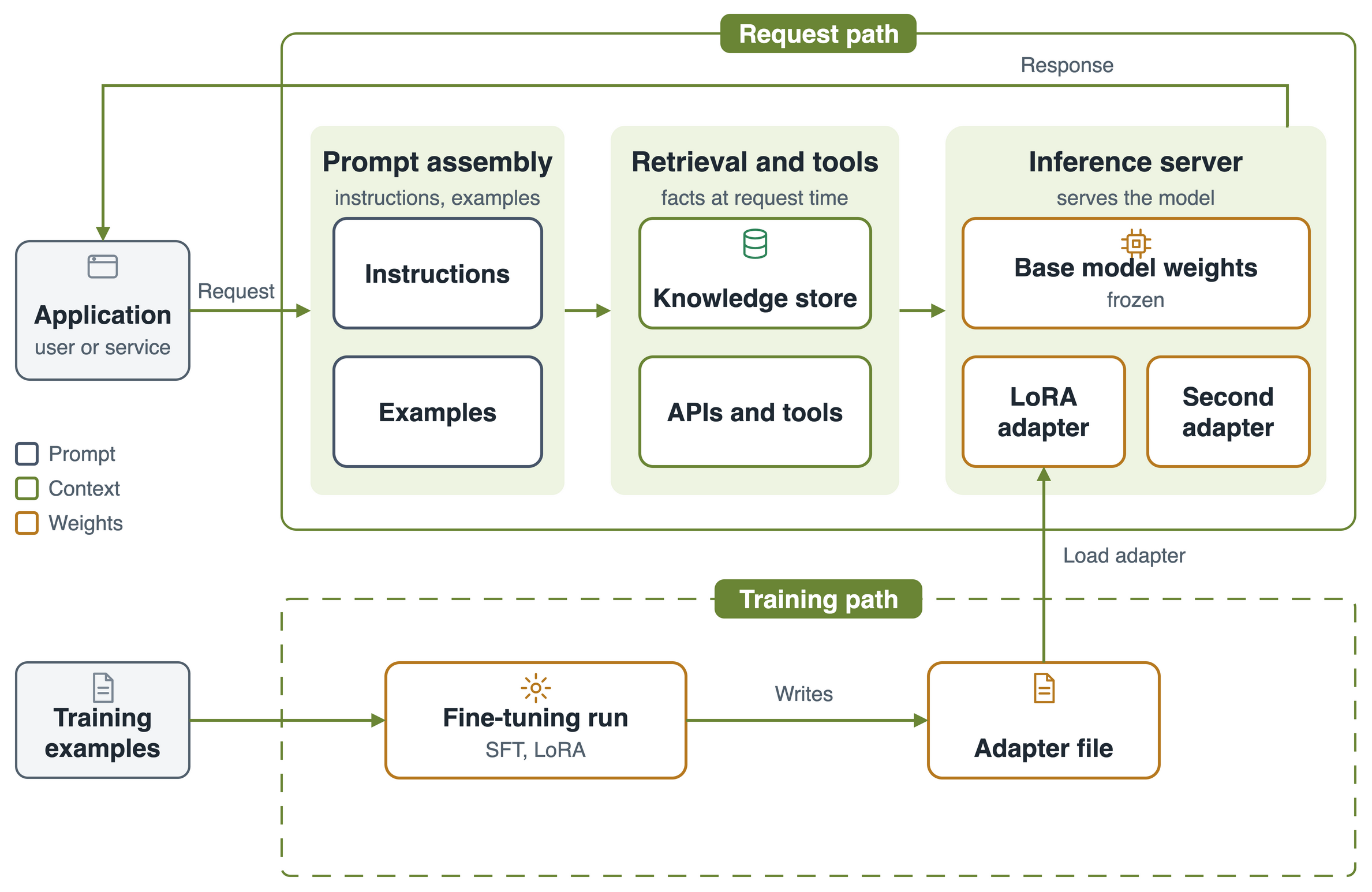 Figure 2. A fine-tuned system. The request path is unchanged by training; the training path produces only an adapter file that the server loads.
On the training path, curated examples feed a fine-tuning run, the run writes an adapter file, and the server loads it next to the frozen base model. Because the adapter is a separate artifact, you can version it, roll it back, swap it, and serve several on one base. That separation is why LoRA became the default, and why later sections ask who holds the adapter.
Why teams fine-tune
Six business cases keep recurring.
-
Consistent behaviour. If an application needs a guaranteed schema, a fixed voice or an in-house taxonomy applied identically across thousands of calls, fine-tuning installs the behaviour that prompting only requests. Adaption's review frames the payoff as consistency, accurate tool use and lower cost.
-
Domain skill. Clinical coding, contract redlining or an internal API surface is not the average case frontier models are built for, and training on your own corpus can close the gap.
-
Cheaper inference. Tinker's customer page reports that Bridgewater trained Qwen3-235B on six financial filtering tasks and reached 84.66% held-out accuracy against 78.2% for GPT-5.5 at about one fourteenth of the inference cost. These are vendor-published figures, not an independent measurement, but they show the pattern: a tuned open-weight model beating a prompted frontier model on a narrow task, at a fraction of the serving cost.
-
Multi-step tool use. Training against a checker for correct tool orchestration is a leading RL workload; Snowflake's announcement says OpenHands uses RL frequently for coding tasks.
-
Privacy and sovereignty. With open weights, data and model stay under your governance and no vendor can revoke access or reprice. Snowflake's pitch is that data, weights and optimizer state remain in its managed environment.
-
Latency and edge. A tuned 4B to 8B model on one GPU or a laptop answers faster than a remote API and works offline.
None of this is free of objections. The table gives the usual ones and what holds up.
| Objection | What holds up |
|---|---|
| Retrieval is cheaper and good enough | True for knowledge gaps. It does not change behaviour, and a tuned small model plus retrieval often beats either alone. |
| Frontier models improve so fast that a tune is obsolete in months | A real risk for generic capability. It is weaker for proprietary behaviour, and re-distilling onto each new base keeps refresh cheap. |
| You need a dedicated ML team | Less true at the LoRA tier, where browser UIs and managed APIs exist. RL still takes real skill. |
| Training data is a liability | Manageable with provenance and PII controls, which data-platform vendors sell. |
When to fine-tune
Do not fine-tune until you can measure the gap. Climb one rung at a time and stop when the problem is solved. Prompting and few-shot examples fix format and most instruction-following complaints. Retrieval and tools fix knowledge gaps. Structured output with constrained decoding fixes schema violations without training. Only when behaviour is still inconsistent with knowledge in place does supervised tuning earn its cost; preference tuning, RL and distillation come after, each for a specific symptom.
| Symptom | Usual lever |
|---|---|
| The model lacks recent or private facts | Retrieval |
| Right facts, wrong format, tone or schema | LoRA SFT |
| Output is acceptable but not excellent along an axis you can name | Preference tuning |
| Multi-step tool use fails and failures are checkable | RL with verifiers |
| A frontier API is too slow or costly for a narrow task | Distill into a 4B to 8B model |
| The model is alien to your field's language | Continued pretraining, then SFT |
| It is the first week of the project | Not fine-tuning yet; build the evaluation set first |
Figure 3 turns the logic into a flow. Can a clearer prompt or schema fix it? Can retrieval or tools? Is there a measurable behaviour gap on a stable task with examples? Only a yes at the last gate leads to SFT with LoRA, and then to preference tuning, RL or distillation where they apply. Every other path loops back to building the evaluation set.
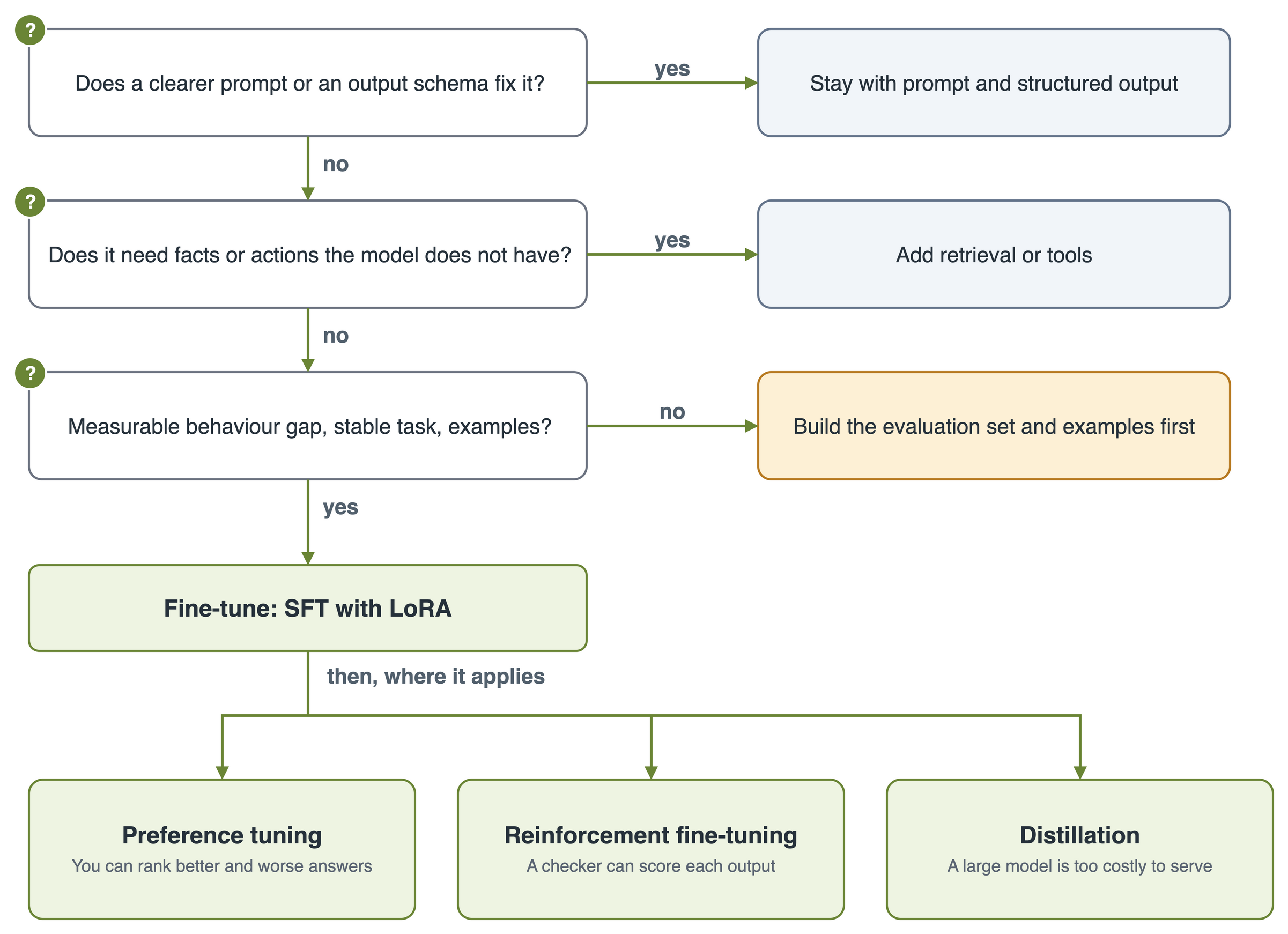 Figure 3. The decision flow. Fine-tuning is the outcome of three failed cheaper options, not the first move.
You are ready to fine-tune when five things are true:
- A frozen, versioned evaluation set exists, on the order of a few hundred task examples, with a metric that moves. If you cannot measure the gap, training cannot close it.
- You have the examples: roughly 500 to 1,000 good SFT examples, 200 to 500 preference pairs, or about 100 verified tasks plus a reward signal for RL. Quality beats volume; LIMA showed 1,000 carefully curated examples can go a long way.
- The task is stable and will not be redesigned next sprint.
- Prompting and retrieval have plateaued with logged scores, not impressions.
- You have decided where the artifact lives: an adapter you own, or a vendor-hosted custom model.
LIMA was “fine-tuned with the standard supervised loss on only 1,000 carefully curated prompts and responses.” — Zhou et al., LIMA: Less Is More for Alignment, 2023
Know when to stop. Do not fine-tune for knowledge that changes, such as prices or inventory. Do not fine-tune on under a hundred examples with no evaluation set; you will overfit. And keep a refresh path if the next frontier model could erase the requirement.
Fine-tuning methods
SFT and LoRA
SFT trains on input-to-output pairs: instructions, chat transcripts, tool-call traces. Full-parameter SFT updates every weight and gives the best quality on demanding tasks, but a 70B model needs a multi-GPU node. PEFT freezes the base and trains small low-rank matrices; per the PEFT documentation, a small fraction of parameters is trainable and the adapter is megabytes in size.
LoRA is the default. QLoRA runs LoRA over a 4-bit quantized base; its authors fine-tuned a 65B model on a single 48 GB GPU. Variants such as DoRA refine the method further. Research on LoRA versus full tuning found that LoRA learns less but also forgets less, which is why it suits narrow tasks.
“LoRA can reduce the number of trainable parameters by 10,000 times.” — Hu et al., LoRA: Low-Rank Adaptation of Large Language Models, 2021
“LoRA better maintains the base model's performance on tasks outside the target domain.” — Biderman et al., LoRA Learns Less and Forgets Less, 2024
Preference tuning
When answers are acceptable but not excellent along an axis you can articulate, such as conciseness or tone, you train on chosen and rejected pairs. RLHF with PPO is the original recipe and is operationally heavy. DPO turns the same idea into a direct supervised loss with no reward model and no sampling loop, and it is the version managed services offer. ORPO, KTO and SimPO are lighter variants that fold preference into SFT, use thumbs-up labels, or drop the reference model.
RL post-training
RL fits when you can verify correctness. In GRPO-style training, the model samples a group of answers, each is scored by a unit test, an exact-match check or a rubric, and answers above the group average are reinforced, with no value model. DeepSeekMath introduced GRPO, and DeepSeek-R1 showed it can elicit reasoning at scale.
Reward sources, from most to least reliable, are verifiable checks, rubric-based model graders and learned reward models. Start from an SFT checkpoint rather than cold; pure cold-start RL is fragile. Vendors also sell managed reinforcement fine-tuning, billed by training time plus grader tokens, which makes your configuration the cost driver.
Distillation
A large teacher produces outputs and a small student learns from them. Off-policy distillation collects teacher outputs once and runs SFT on them: cheap and stable. On-policy distillation has the student generate while the teacher scores it: usually better, with more compute. The standard cost play is distilling a tuned large model into an 8B for production; the framework dates from 2015.
Continued pretraining
This adapts the base model to a domain corpus before SFT: law, medicine, code, a low-resource language. Mangled vocabulary and heavy tokenization waste are the signs. As a rule of thumb it pays off only at large scale, roughly a billion tokens or more, and managed services cap how much corpus a single job can take.
The cheat sheet
| Method | Data needed | Relative cost | Best for |
|---|---|---|---|
| SFT with LoRA | 500 to 50k pairs | Low | Format, tone, domain task skill |
| Full-parameter SFT | 5k to 500k pairs | Medium | Deeper change on 70B-class models |
| DPO, KTO, ORPO | 200 to 50k pairs | Medium | Style control, quality polish |
| GRPO, RLVR, RFT | Tasks plus verifiers | High (billed by time) | Reasoning, multi-step tool use, code |
| Distillation | Teacher outputs | Low to medium | Lower cost at fixed quality |
| Continued pretraining | A billion tokens or more | Very high | Adopting domain language |
The data ranges and cost tiers are the source report's rules of thumb, not vendor-published figures.
How training is delivered
You can run training yourself on rented or owned GPUs, submit a dataset to a managed service that bills per million training tokens, or use a serverless training API, the newest option and the one most worth understanding.
In a serverless training API you write the training loop; the vendor runs the GPU steps. Your script, data loader and recipe library (TRL, veRL, SkyRL, Unsloth) run on a laptop or CPU-only machine. The API exposes primitives: a forward and backward pass, an optimizer step, and sampling for rollouts and evaluation. Tinker names them forward_backward, optim_step and sampling; Together Post-Training and Fireworks' training API document the same shape, and Snowflake documents equivalent REST steps, including that no local GPU is needed.
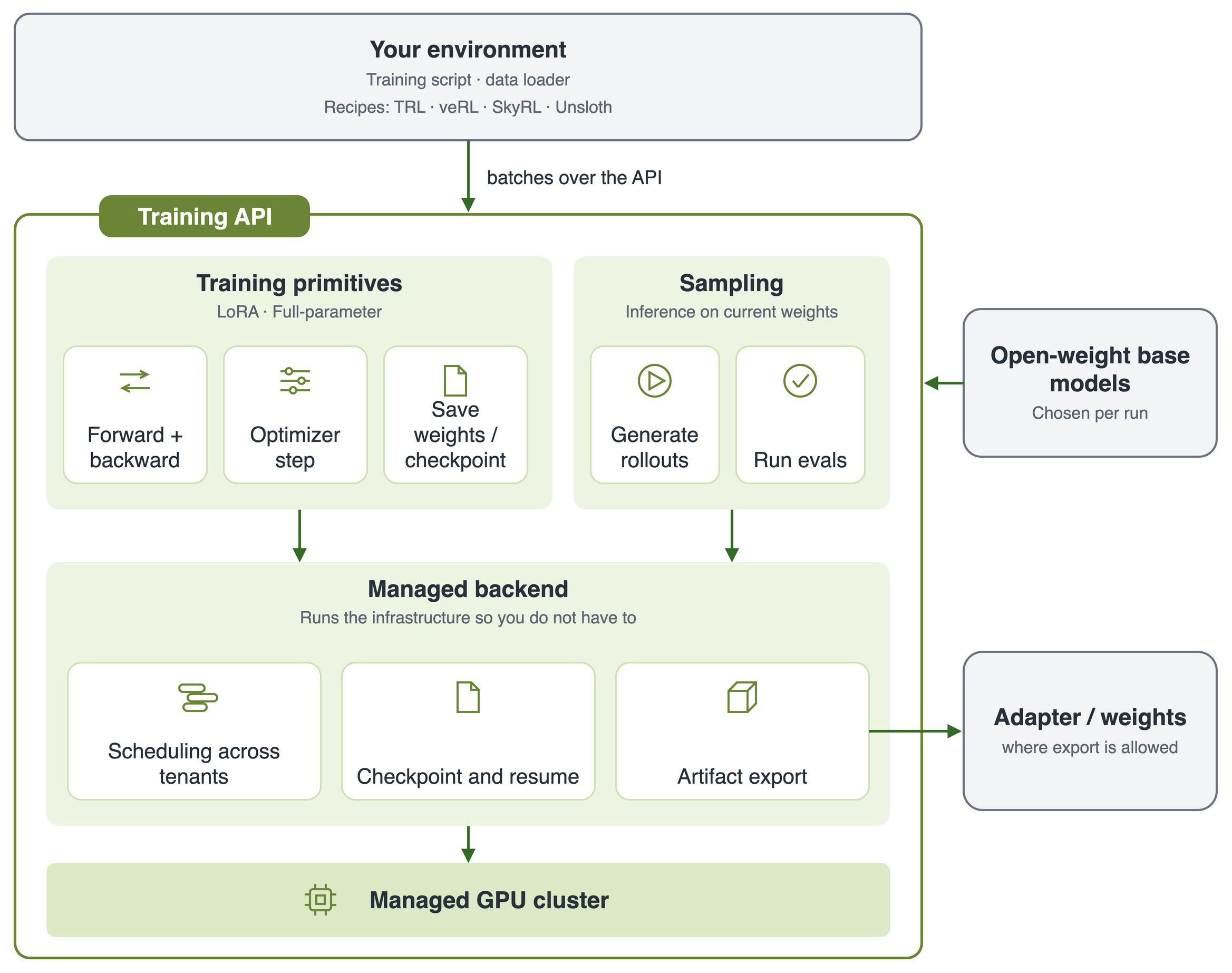 Figure 4. A serverless training API. Orchestration stays in your environment; the managed backend schedules the GPU work and, where permitted, exports the adapter.
Figure 4 shows the split. Open-weight base models enter as inputs; the managed backend handles scheduling, checkpoints and artifact export on its own GPUs. You keep the loop, so you can change the algorithm, loss or reward without waiting for a vendor feature. You rent the cluster, so there is no GPU debugging.
The services we checked (Tinker, Snowflake, Together) all train open-weight models. Tinker launched on October 1, 2025, so the category is about a year old.
Open-source tooling
The open-source toolchain is mature enough to start on a single GPU. Every stage of the pipeline has an open-source option. The table is a starting set, not an endorsement of one stack.
| Stage | Tools | Notes |
|---|---|---|
| Training and RL | Unsloth, Axolotl, LLaMA-Factory, TRL, PEFT | Unsloth for single-GPU efficiency, Axolotl for config-driven multi-GPU, LLaMA-Factory for a web UI, TRL as the reference post-training library; veRL, SkyRL and Prime-RL for larger RL rollouts |
| Data | Hugging Face Datasets, Argilla, distilabel, Label Studio, Prime Intellect Verifiers | Formats, annotation, synthetic data, RL environments |
| Evaluation | lm-evaluation-harness, lighteval, Inspect AI, promptfoo | Benchmarks for sanity, app-level evals for selection |
| Serving | vLLM, SGLang, TGI, llama.cpp, Ollama | vLLM serves several LoRA adapters on one base model; llama.cpp and Ollama cover local and edge |
Evaluation is the most under-invested layer. Build a task-specific set from real production cases before training, and treat generic benchmarks as sanity checks. Maintenance changes quickly: Hugging Face's AutoTrain and PyTorch's torchtune are both no longer actively maintained, so check a tool's status before adopting it.
The market in 2026
Closed-model tuning is narrowing unevenly while open-weight post-training becomes a market. Figure 5 maps who sells what as of November 2026. Five groups sell open-weight or hosted training: data clouds, hyperscalers, open-weight specialists with training APIs, serverless GPU clouds and no-code tools. A sixth lane, frontier-lab closed-model tuning, is narrowing, but not uniformly.
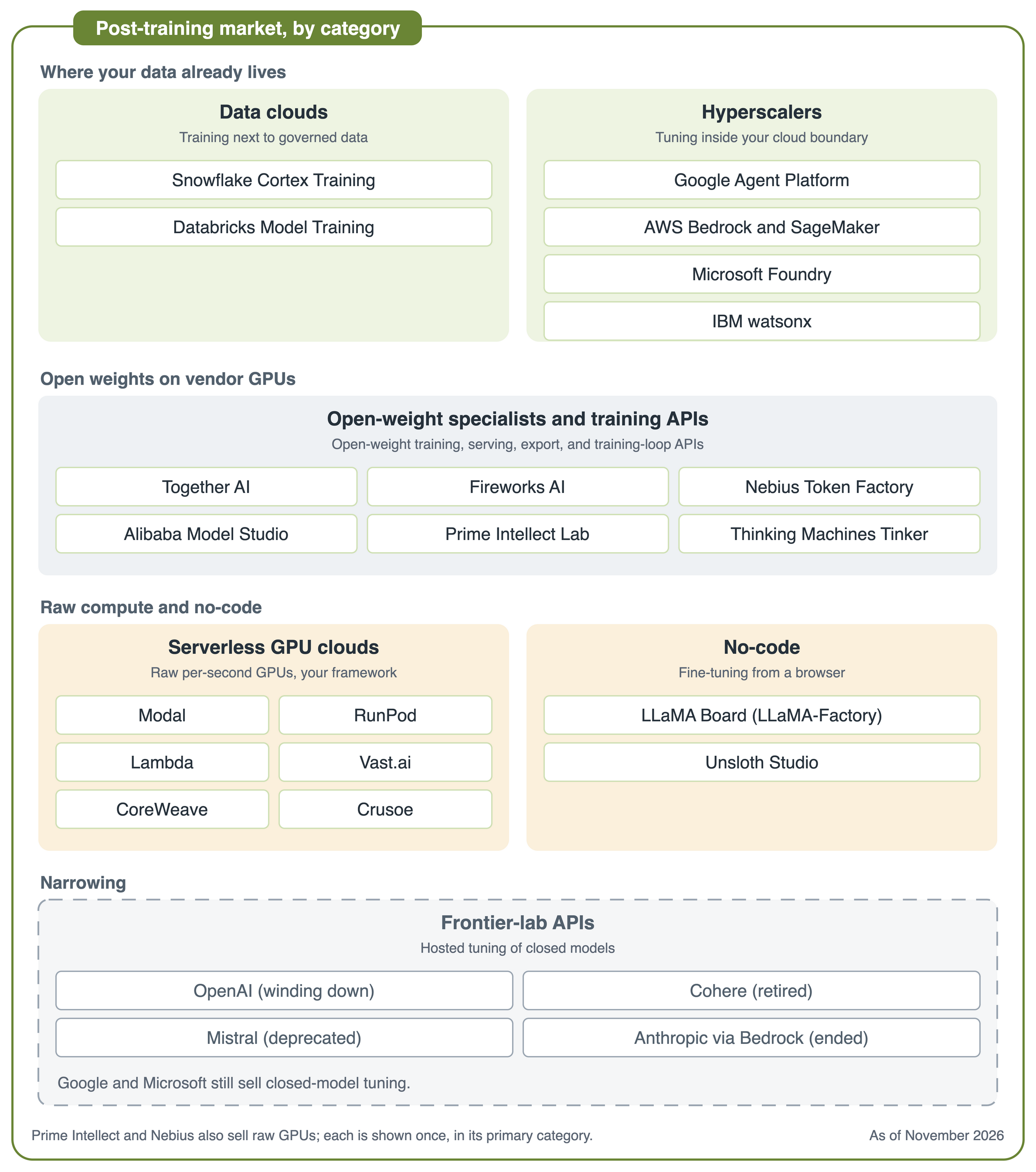 Figure 5. The market map as of November 2026. The frontier-lab lane is shrinking, but Google and Microsoft still sell closed-model tuning.
| Frontier-lab route | Status as of November 2026 |
|---|---|
| OpenAI | Since May 7, 2026, organisations that had never run fine-tuning cannot create jobs. From January 6, 2027, existing customers will also be unable to create new jobs. Fine-tunes of named GPT-4o and GPT-4.1 snapshots will shut down with their base models on January 14, 2027. |
| Cohere | Retired fine-tuning for its Command, Command-R, Classify and Rerank models on September 15, 2025. |
| Mistral | Its documentation marks fine-tuning deprecated and no longer actively supported, with no end date. |
| Anthropic | Claude 3 Haiku tuning was offered through Amazon Bedrock; the model reached end of life on Bedrock on September 10, 2026. |
| Not retreating. Supervised tuning for Gemini 3 became generally available on October 19, 2026 on the Gemini Enterprise Agent Platform, formerly Vertex AI. | |
| Microsoft | Foundry still offers supervised and reinforcement tuning of OpenAI models. |
Our reading: a hosted-only custom model, whose weights you cannot download, carries the retirement risk of its base model. OpenAI's own rule is that fine-tunes follow their base model's schedule.
On the open-weight side, the platforms differ in what they hand back. Portability is the difference that matters most when a vendor changes course.
| Provider | Can you take the trained weights? | Notes |
|---|---|---|
| Together, Nebius, Tinker | Yes, Together, Nebius and Tinker let you download checkpoints | For LoRA the artifact is the adapter, not a merged model |
| Fireworks | Serves your adapters on its own deployments | Download terms not documented in the pages we read |
| Snowflake Cortex Training | Weights stay in Snowflake | Intentional, for governance |
| Google Gemini tuning | No documented download path | |
| Amazon Bedrock custom models | No documented download path | Llama custom models are served on Provisioned Throughput |
| Alibaba Model Studio | No; exported snapshots cannot be downloaded |
Snowflake's preview runs in all commercial AWS regions, and its trainable models at launch are all Qwen. The documentation says only evaluation deployments are supported, and Snowflake's preview terms limit previews to internal evaluation. Snowflake also claims up to 61% lower cost than Tinker and other serverless training APIs, in its own LoRA SFT benchmark against list prices of October 22, 2026; measure your own workload.
Consolidation is visible too. Rubrik announced its acquisition of Predibase in June 2025. Cloudflare announced that Replicate was joining it in November 2025. Nscale agreed to acquire Anyscale in a deal announced July 30, 2026, and not shown as closed. Databricks now calls its product Databricks Model Training, and its documentation says the older fine-tuning service has reached end of life.
What it costs
A small LoRA job costs tens of dollars, and the sticker price is the smaller part of the bill. Take one reference job: 50,000 examples of about 1,000 tokens each, three epochs, which is 150 million training tokens, with LoRA SFT on an 8B-class model. At a per-million-token rate, the cost is the rate multiplied by 150.
| Platform and model | Rate per 1M tokens | Cost for 150M tokens |
|---|---|---|
| Together, Llama 3.1 8B | $0.34 | $51.00 |
| Tinker, Qwen3-8B | $0.44 | $66.00 |
| Fireworks, models up to 16B | $0.50 | $75.00 |
| Google Cloud, Llama 3.1 8B | $0.67 | $100.50 |
| Amazon Bedrock, Llama 3.1 8B (US West, Oregon) | $1.49 | $223.50 |
Prices are vendor-published, read in November 2026; Tinker's are stamped October 19, 2026. Google bills per training token times epochs. Treat the table as a snapshot.
The spread is about 4.4x across vendors, on a job that costs a few hundred dollars at most. Beyond plain LoRA SFT, multipliers apply: Fireworks prices full-parameter training at about twice LoRA and DPO at twice SFT, while Together lists DPO at about 2.5x its SFT rate. Together's per-job minimum ranges from $4 to $60 depending on the model, which matters for many small experiments.
What the sticker price hides is mostly not compute. In our judgement data preparation (deduplication, PII scrubbing, licence checks) is the largest cost for most teams, though we have no sourced multiple. Evaluation and refresh cycles add more. Serving can also carry a floor: on Bedrock, custom Llama models are hosted on Provisioned Throughput at about $24 per hour per model unit with no commitment, plus $1.95 per custom model per month for storage.
Databricks' published example, Llama 3.3 70B on 10 million training words, is about $146 at $0.65 per DBU, but it counts words rather than tokens and the units are not comparable to the table above.
RL costs are harder to quote: managed reinforcement fine-tuning is billed per training hour plus grader tokens, so wall-clock time and grader size drive the bill. Cap steps and alert on spend.
Data and base models
Data and the choice of base model decide quality more than the method does.
From examples to environments
For SFT you buy or curate examples. For RL you engineer tasks and graders, so what teams buy is shifting from labelled examples toward environments a model can practise in. The signals are concrete: Mercor announced in July 2026 that it would acquire Deeptune, a maker of RL environments, and Prime Intellect's hub lists more than 2,500 community environments. For RL projects, environment and rubric design is the project.
Governance basics apply to every method: keep a licence chain to the content owner, scrub personal data, and deduplicate train and evaluation sets, because contamination explains many fine-tuning results that look too good to be true. Validate rendered samples before launch too; chat-template mismatches and tool-call drift ruin more runs than weak learning does.
Choosing a base model
An 8B-class dense model is the workhorse for task and format models: cheapest to train and serve, with LoRA on one GPU. Go smaller for latency, edge or routing, and to 27B when quality earns the serving cost. Mixture-of-experts models give large-model quality with few active parameters but are heavy to train, so use LoRA. Qwen, DeepSeek, gpt-oss, GLM, Gemma and Llama are all trained on the platforms above; check each licence file, because open weights do not always mean unrestricted use.
Base-model churn is a lifecycle risk even for open weights, because platforms rotate their catalogs. Pin the base weights locally, keep adapters small and re-trainable, and script the evaluation so a base swap is a re-run rather than a rewrite.
The playbook
Figure 6 shows the pipeline as four layers on GPU compute: data, training, evaluation and serving. The arrow that matters most runs backwards: production failures flow into the next dataset version. That loop is the reason a fine-tuned system improves instead of rotting.
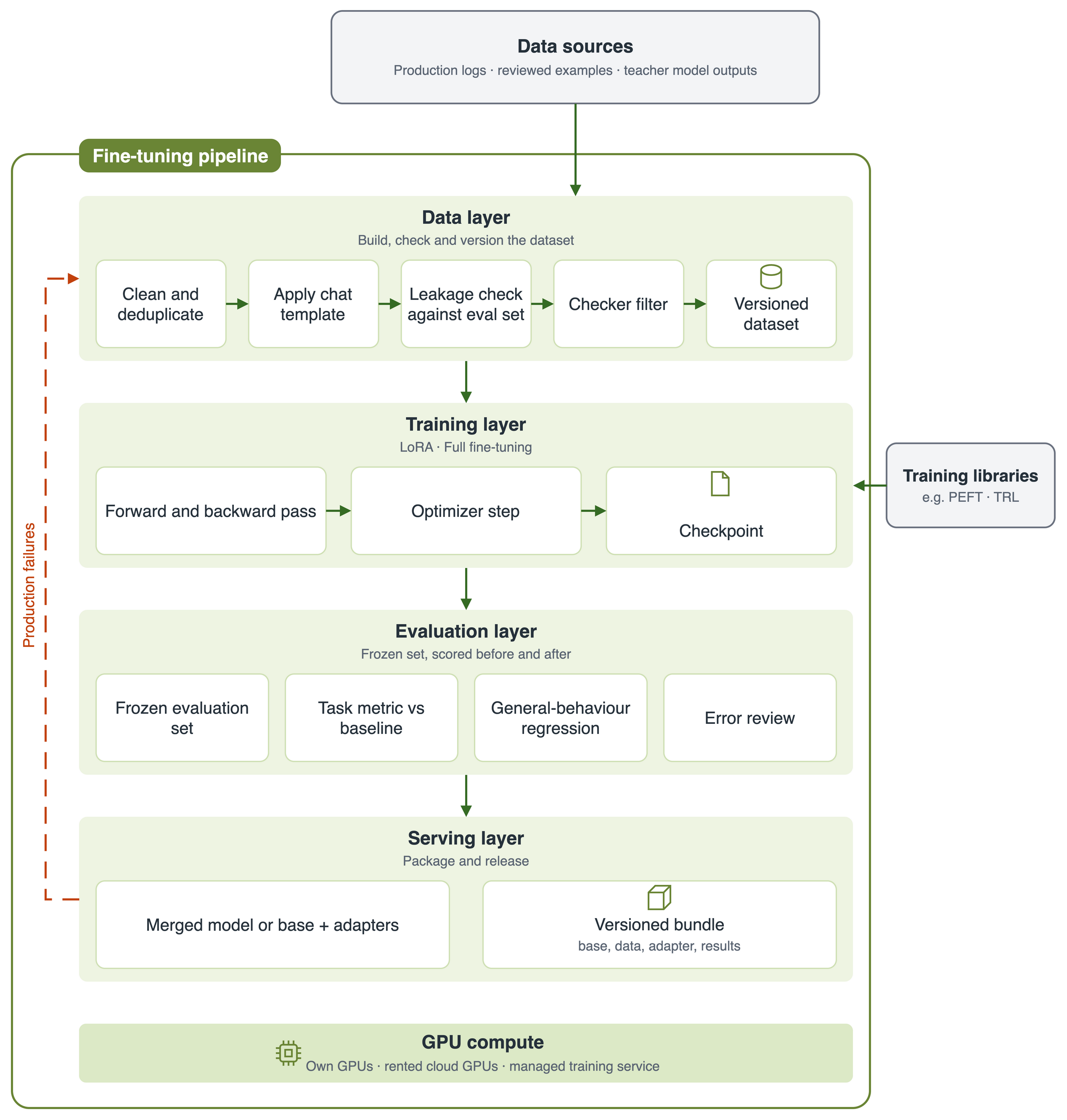 Figure 6. The pipeline architecture. Production failures feed the next dataset version, closing the loop.
| Step | Phase | Output | Failure it prevents |
|---|---|---|---|
| 1 | Define the task, owner and metric | One-paragraph spec and metric | Training for vibes |
| 2 | Baseline with prompting and retrieval | Evaluation harness and baseline score | Not knowing whether tuning helped |
| 3 | Assemble data: harvest, scrub, dedupe, decontaminate | Versioned dataset | Leakage and licensing problems |
| 4 | Pick the method and platform, favouring exportable weights; SFT with LoRA first | Method decision | Over-engineering and lock-in regret |
| 5 | Run the smallest serious training: rank 16 to 32, one to three epochs | First checkpoint | Wasted spend on full tuning |
| 6 | Evaluate against baseline and read about 50 failures | Go or no-go and a data-fix list | Silent regressions |
| 7 | Iterate: fix data first, then hyperparameters; try DPO or RL only if SFT plateaus | Champion model | Method-first thinking |
| 8 | Deploy: merge or load the adapter, shadow-test | Production endpoint | Gold-plating |
| 9 | Monitor and refresh | Next dataset version | Model rot |
The phases map to four paths. Path A is self-hosted on one GPU: the most control and the most operational work. Path B is a serverless training API where you keep the loop. Path C is a managed per-token service: upload JSONL, pick a model and method, get an endpoint, and check export terms first. Path D is RL fine-tuning: formalise the task as an environment with a verifier, start from an SFT checkpoint, and watch the billing.
The evaluation loop has four parts: a task evaluation on your frozen set against baseline; sanity benchmarks for instruction-following and reasoning; regression cases, perhaps 20 to 50 things the model must still do, to catch forgetting; and model-as-judge scoring for subjective axes such as tone, with a human-audited subset.
Risks and governance
Most training risks are data and billing problems, not algorithm problems.
| Risk | What it looks like | Mitigation |
|---|---|---|
| Catastrophic forgetting | The tuned model loses general skills such as formatting or refusals | Prefer LoRA, which forgets less; mix in general data; run regression cases |
| Overfitting on small data | Training and evaluation scores diverge; repetitive output | One to three epochs, early stopping, quality filtering |
| Format debt | Template or tool-syntax mismatches quietly corrupt training | Inspect rendered tokens before every launch |
| RL instability and billing | Reward hacking; hourly cost that runs away | Review the reward design; set step budgets and alerts |
| Vendor wind-down or lock-in | Hosted custom models stranded by policy | Contract for export and notice; keep the adapter |
For regulated work, keep per model version the data lineage and licences, PII-scrubbing logs, evaluation artifacts, a pinned rollback checkpoint and a vendor exit plan. Treat third-party adapters as untrusted until scanned.
Outlook
The following are our interpretations of the evidence above, not facts.
- Serverless training APIs become a standard primitive. Four vendors shipped similar shapes within a year.
- Post-training moves toward data platforms. Snowflake and Databricks both sell training near governed data, which squeezes standalone fine-tuning services.
- Closed-model tuning narrows, with exceptions. With OpenAI's January 6, 2027 cutoff approaching and no successor announced, demand either moves to Google and Microsoft or to open weights.
- RL grows and environments become the scarce asset. Vendor roadmaps and data-vendor acquisitions both point that way.
- Narrow tuned models beat prompted large ones more often. Expect portfolios of small tuned models behind a router.
Recommendations by team
| Team | Recommendation |
|---|---|
| Startup building on model APIs | Prompts and retrieval first. When a task stabilises and evaluations exist, LoRA-tune an 8B-class open model on a per-token service and always download the checkpoint. |
| Enterprise already on Snowflake or Databricks | Pilot on a non-production dataset while in preview. Compare one SFT run and one retrieval-plus-LoRA hybrid against your frozen evaluation set, and get quotes from other vendors. |
| Cloud-bound regulated team | Use the cloud's managed tuning if compliance demands it, and price the serving floor first. Otherwise open weights on your own compute give you the artifact. |
| ML-heavy product team with multi-step workloads | Build the environment and evaluation harness before anything else. SFT on distilled trajectories, then GRPO on rented GPUs or a training API. |
| Solo developer | Unsloth on your own GPU or a rented one, or LLaMA-Factory's web UI if you prefer not to write code; serve locally with Ollama. |
The decision rule. Knowledge gap, use retrieval. Behaviour gap, use LoRA SFT. Judgement gap, use DPO. Verifiable-task gap, use RL. Cost gap, distil. Governance gap, use a data-platform service. Lock-in risk, demand weight export.
Frequently asked questions
Is OpenAI ending fine-tuning? It is winding it down, with a narrow scope. Since May 7, 2026, organisations that had never run fine-tuning cannot create jobs. From January 6, 2027, existing customers will also be unable to create new jobs, and fine-tunes of named GPT-4o and GPT-4.1 snapshots will shut down with their base models on January 14, 2027. Microsoft's Foundry still offers tuning of OpenAI models.
What is a serverless training API? A service where your code runs the training loop and the vendor's GPUs run the compute steps, namely the forward and backward passes and the optimizer step, over an API. Publicly documented examples are Tinker, Snowflake Cortex Training in preview, Together Post-Training and Fireworks' training API.
How much does a first fine-tune cost? For LoRA on an 8B-class model with 150 million training tokens, vendor rates in November 2026 put compute at roughly $51 to $224, from Together at $0.34 per million tokens to Bedrock at $1.49.
Can I take the trained model with me? It depends on the vendor. Together, Nebius and Tinker let you download checkpoints, and for LoRA the download is the adapter. Alibaba says exported snapshots cannot be downloaded, Snowflake keeps weights in Snowflake, and Google's Gemini tuning and Bedrock custom models have no documented download path.
Further reading
- Snowflake's Cortex Training announcement and its documentation, for the preview scope and architecture.
- An independent analysis of Snowflake's 61% claim, a secondary source.
- OpenAI's deprecations page, the primary record of its fine-tuning schedule.
- Tinker and the Tinker Cookbook, for training-loop recipes.
- The papers behind the methods: LoRA, QLoRA, InstructGPT, LIMA, DPO, Tülu 3, DeepSeekMath and DeepSeek-R1.